Car keys · Toronto
Motorcycle & Scooter Keys
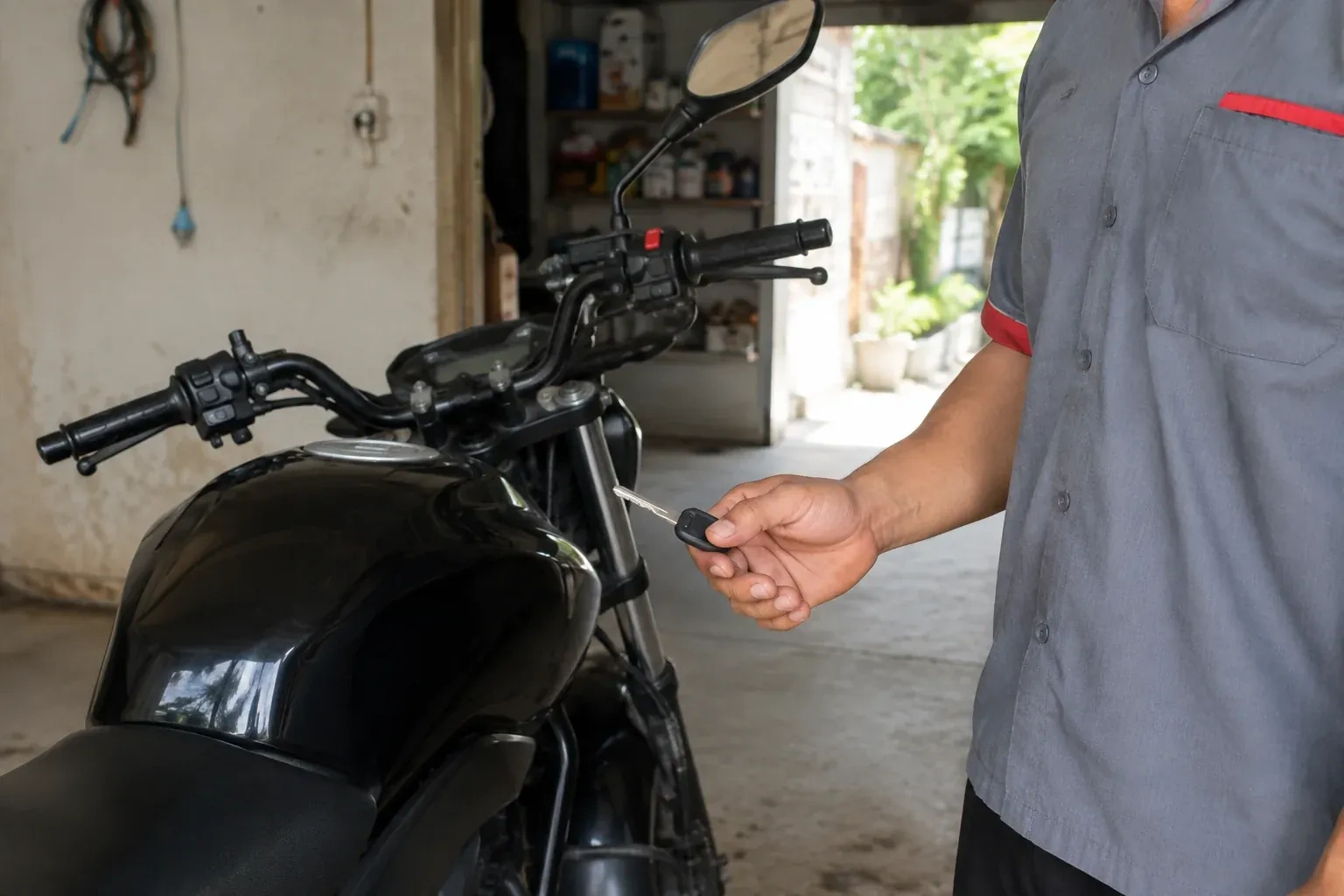
The dash lights come on, the starter cranks, and the engine simply refuses to catch, though the same key has run this bike since it was new. It could be the key and ignition module no longer agreeing, or an ordinary fuel or ignition fault sharing the same…
Motorcycle & Scooter Keys
In plain words
Newer machines add an electronic layer to a mechanical lock: a chip inside the key carries a coded signal that the ignition module checks before letting the engine run, so a correctly shaped blade that lacks the right chip will turn the switch without starting anything. Producing a working key for one of these machines means pairing a new transponder to the vehicle's electronics where that system supports it, using either an existing key as a reference or equipment built for it, though some systems need a dealer procedure or a code key only the manufacturer issues.
How the visit goesThe key still opens the seat and unlocks the fork, but at the ignition it needs a slow half-turn and a small lift before the switch engages, a habit that has crept in over years of daily starts.
Toronto
How the visit goes
Any prior work or damage
Before starting, the locksmith asks whether anyone has already tried to open or copy the lock: a hardware-store duplicate that never worked well, a bent key left in the barrel, or an attempt with an improvised tool that scratched the keyway. Any of this changes what is found once the lock is opened up, and knowing about it in advance means the owner is told plainly what was already there rather than assuming new damage happened during the visit. It also sometimes explains a wafer that has been sitting slightly out of place for months.
Decoding a lock with no key at all
Without any key to copy, the lock has to speak for itself. The locksmith picks the cylinder and reads each wafer's resting depth with feeler tools or a small scope, or uses a decoder built for that keyway, translating what is found into a cutting code. A key is then cut to that code and tested in the lock before being trusted on the ignition proper. This route takes longer than copying an existing key, since every wafer has to be read individually, but it produces a key that matches the lock exactly rather than an approximation.
What the immobiliser now expects
On a machine with an immobiliser, the electronics now recognise every key that was paired during the visit and nothing else, which is worth knowing if an old key turns up later: it will still fit the ignition mechanically but will not start the engine on its own. Any spare transponder key made afterward should go through the same pairing process rather than being assumed to work by shape alone. Keeping a note of how many keys are currently paired to the machine makes a future visit, whether for a lost key or an added spare, easier to sort out.
Motorcycle & Scooter Keys
In the van
- Replacement transponder chips
- Fob shells and batteries
- Torx and security bits
- Pick and tension tools
- Code-cutting machine
What affects the quote
Same fees day, night or weekend
1Whether a working key already exists
Whether a working key still exists changes the job considerably: cutting or duplicating from one is the more direct route, while decoding a lock with nothing to reference takes longer and shapes the time reflected in the total.
2Time spent decoding a lock
Decoding a lock with no key at all, reading every wafer individually, takes longer than copying from an existing key, and that additional time is part of what the quote reflects.
3Condition of the steering lock
A steering lock that turns freely adds little to the visit. One that has seized from weather or disuse needs patient freeing before any key can be tested against it, which takes extra time.
Motorcycle & Scooter Keys: questions
I only have the key, not the bike here. Can you still cut one from it?
Yes, a key on its own can usually be read and duplicated without the machine present, since the cuts on the blade carry the information the locksmith needs. What cannot be confirmed without the bike is whether an immobiliser is fitted or whether other locks are keyed the same way, so bringing the machine, or at least a photo of the ignition and dash, helps decide whether anything beyond a straightforward copy is needed.
Can a locksmith program a new immobiliser or transponder key?
On many machines that carry one. The mechanical cut and the electronic pairing are handled as two separate steps: the key is shaped to fit the lock, then its chip is taught to the vehicle's module using an existing key or programming equipment built for that system, where the maker's own security rules allow it. Both steps are tested with a full engine start, since a key can turn the switch and still fail to start the machine if the chip was never paired.
Why does the number of wafers in a lock matter?
Each wafer represents one depth the key has to hit precisely for the lock to turn, so a lock with more wafers has more combinations and takes a little longer to decode or pick than a simpler one. Most motorcycle locks use around five wafers, and manufacturers sometimes space the depth increments further apart specifically to reduce the chance that an unrelated key happens to fit. This is why an ordinary-looking key rarely works in an unrelated bike.
Car Keys
- Car Key ReplacementThe fob went through the washing machine in a jacket pocket.
- Spare Car Key DuplicationA teenager just passed a driving test and reasonably wants a key of their own rather than…
- Key Fob ProgrammingThe remote clicks the way it always has, but the vehicle no longer locks, unlocks or answers with…
Motorcycle & Scooter Keys near you
One team handles every service on this page for Toronto, so a lockout can turn into a rekey, and a rekey into a properly set deadbolt, within the same visit if you want it. Each service is described separately below, but at the door they fit together as one piece of work.