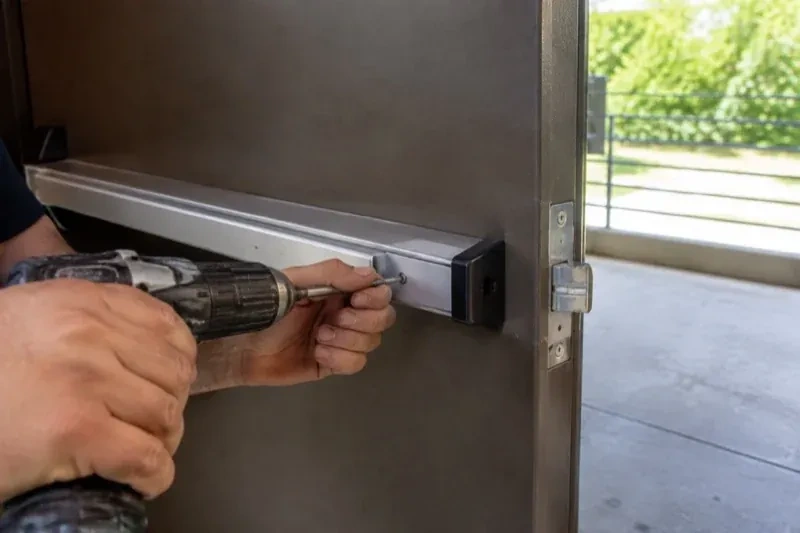
Commercial · Toronto
Panic & Exit Hardware in Toronto
Two doors used to swing as a pair at the community hall entrance, but one leaf has started closing before the other, catching the astragal and leaving a gap wide enough to worry the caretaker.
Panic & Exit Hardware
In plain words
Which device goes on a door depends on what the door already is. A single interior door usually takes a rim exit device and a simple pull or lever outside. Listed fire-exit hardware covers many tall, narrow-stile and fire-rated openings too, so a mortise or vertical-rod device is chosen for its latching arrangement or the door's own preparation, not from height or fire rating alone, and a fire-rated opening can never be held open by a mechanical dogging function. Reading the door correctly before ordering hardware is most of the job; fitting it well is the rest.
How the visit goesA padlock went on the stockroom's back door years ago for security and nobody has thought about it since, until the walkthrough this week pointed out that the same door is the room's only other way out.
Toronto
How the visit goes
Reading the door itself
Every opening gets the same close look: whether it is fire-rated, which way it swings, how wide it is, and what preparation, if any, already exists in the door and frame from earlier hardware. A hollow-metal fire door takes a different device than a wood door in a non-rated partition, and a narrow-stile aluminum storefront door narrows the choice of device further still. Reading this correctly before anything is ordered is what keeps the installation from turning into a second visit once the wrong device arrives and does not fit the preparation already in the door.
Adding electrified functions
Where the plan includes access control or an alarm, the wiring is run and terminated to the device without touching its mechanical exit function: a request-to-exit switch reports that the pushpad or crossbar was actuated, electric latch retraction lets an authorized signal release the latch for entry, and an alarm module sounds locally when the crossbar is used. On a fire-rated opening, electric latch retraction is arranged to relatch automatically the instant a fire-alarm signal comes in, since a fire door has to keep its active latch and cannot rely on a mechanical dogging function to do that.
Room to grow into the next change
If the space changes use again, adds seating, or the occupant load creeps upward with a future renovation, the hardware fitted now is already suited to a use that requires it, rather than something that will need revisiting the moment the room grows busier. Keeping a note of the occupant load the current hardware was specified for means a future change can be checked against that number before it becomes an inspector's finding rather than a planned upgrade.
Panic & Exit Hardware
In the van
- Force gauge
- Installation template and jig
- Door closer
- Signage and labels
- Coordinator for door pairs
What affects the quote
Same fees day, night or weekend
1Door and frame condition
A door that has sagged, a frame that has shifted, or a strike pocket that no longer lines up needs correcting before hardware is fitted, which adds its own line to the quote.
2Condition of the existing hardware
A device that only needs adjustment, cleaning and new fasteners costs less in labour than removing a seized or badly worn device and fitting a replacement in its place.
3Signage and labelling
Any exit signage or alarm labelling the opening needs is a small addition on its own, but it is named in the quote rather than assumed to already exist on the door.
Panic & Exit Hardware: questions
Can a padlock or extra deadbolt stay on a door that has this hardware?
No additional fastening should stay on an exit door that does not release the same way the primary device does. A hasp, padlock or separate deadbolt added at some point for extra security is a common finding on an older door, and removing or replacing it with something that releases under the same push is part of bringing that opening back to a single, reliable exit.
How is occupant load actually counted for this decision?
Occupant load is calculated from the floor area and the intended use of the room, using published factors for that occupancy type, rather than a headcount taken on a busy night. A building official or a locksmith familiar with the calculation can work through it for a specific room, and the result is what decides whether the exit doors serving that room need a releasing device.
What is dogging, and can every door have it?
Dogging holds the device's latch retracted so the door works as a simple push-pull for a period, useful during business hours on a busy entrance. It is not available on fire-rated openings, because a fire door must keep an active latch at all times; on those doors, electric latch retraction achieves a similar push-pull convenience without ever leaving the latch mechanically held back.
Commercial Locks

- Master Key System DesignA self-storage operator wants the office, the tenant gate and the equipment shed on three different…
- Access Control InstallationDeliveries arrive before anyone is scheduled to be there, which right now means either propping the…
- Commercial-Grade Lock ReplacementOvernight someone forced the back door, and the cylinder face is scarred, the metal around the…
Panic & Exit Hardware near you
One team handles every service on this page for Toronto, so a lockout can turn into a rekey, and a rekey into a properly set deadbolt, within the same visit if you want it. Each service is described separately below, but at the door they fit together as one piece of work.